
Manufacturing & Machining
Follow the main stages of advanced ceramic manufacturing, from raw material preparation, forming and sintering to precision machining and surface finishing.
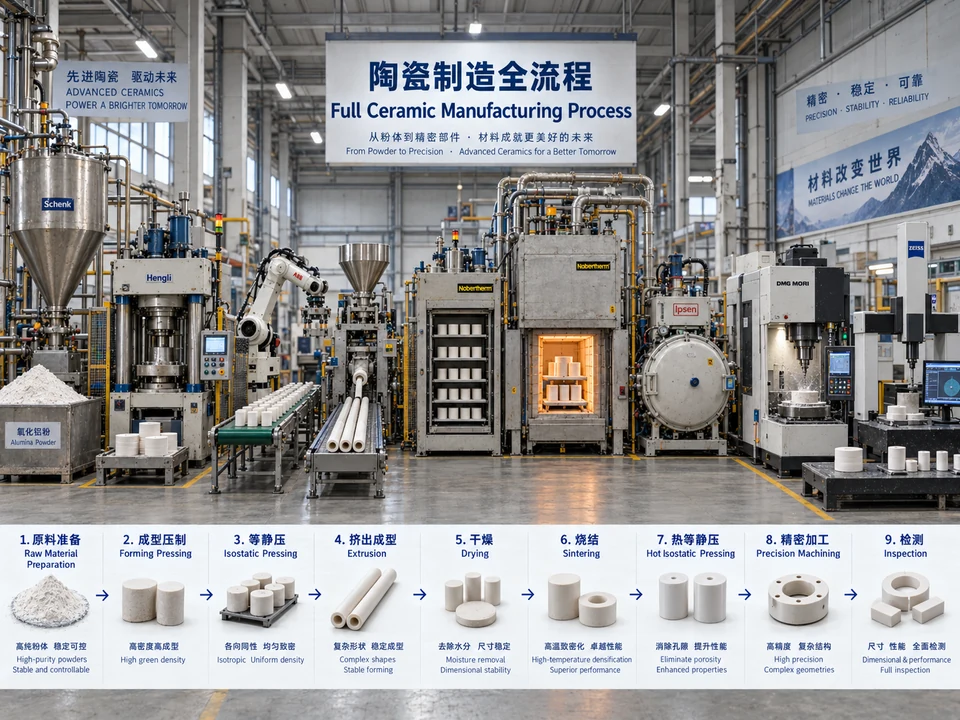
The Manufacturing Route
Ceramic component quality depends on more than machining equipment. Powder characteristics, green density, sintering shrinkage, machining allowances and inspection control all play a role.
- Powder preparation and granulation
- Forming and green-body control
- Sintering and densification
- Precision machining and inspection
Machining Methods & Key Challenges
Machining methods and component geometry influence process consistency and machining time. Tolerances, surface requirements and inspection must be considered together.
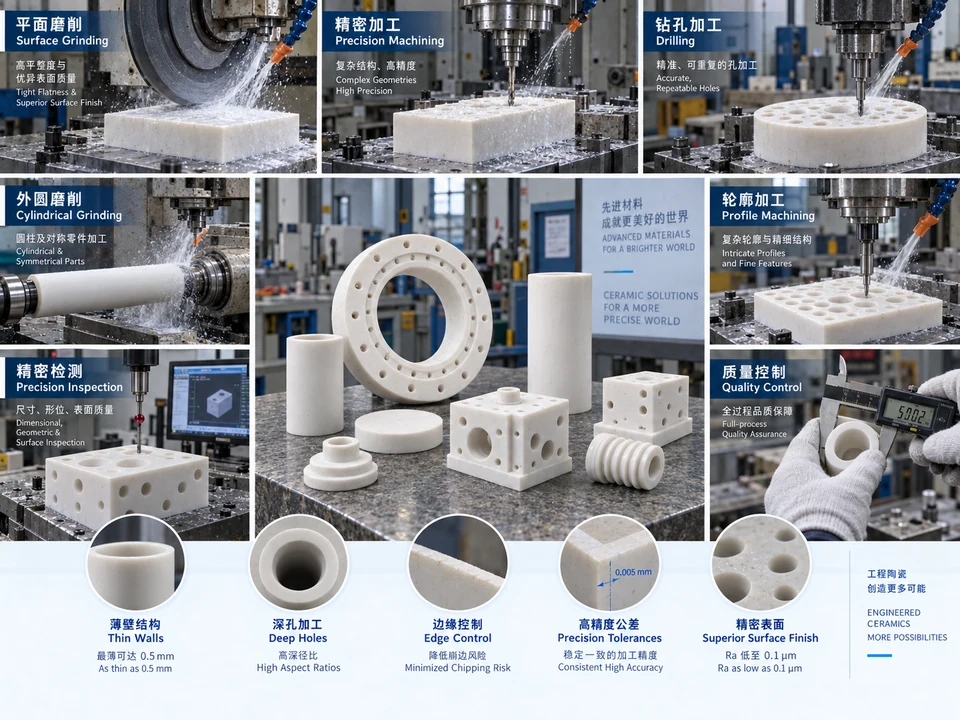
Geometry
Deep holes, narrow slots, thin walls, long components and complex profiles make tool access and crack control more demanding.
Dimensions & Geometry
Combined requirements for dimensional tolerances, coaxiality, roundness and flatness increase manufacturing and inspection demands.
Surface Quality
Sealing faces, mirror finishes and stringent surface roughness requirements may call for additional lapping, polishing and process verification.
Inspection
The combination of CMM measurement, roundness, surface roughness and functional testing influences inspection planning.
This page presents general processes and engineering considerations. It does not imply that every illustrated machine or process is operated in-house; the manufacturing scope is agreed for each requirement.
Process Scope & Requirement Details
Forming, sintering, grinding, drilling, lapping and polishing are within our scope. Required operations depend on the component condition and target requirements.
Forming & Sintering
Discuss the material, target geometry, quantity and surfaces requiring subsequent machining. Forming, sintering and machining allowances should be considered together for each material and geometry.
Grinding & Drilling
Define surfaces, hole positions and depths, dimensions and geometric requirements. Include constraints from thin walls, edges and adjacent features so that fixturing and tool access can be assessed.
Lapping & Polishing
Identify the surfaces and their flatness, roughness, appearance or mating requirements. A mirror-like appearance and compliance with dimensional, geometric or functional requirements must be specified separately.
Contact Us
Contact us by telephone or email to discuss advanced ceramics, precision machining, component design, inspection and joining.
Before You Get in Touch
- Drawings & GeometryComponent name, drawing revision, main dimensions and critical features.
- Material & Service ConditionsKnown material or grade, intended use and operating conditions.
- Quantity & TimingQuantity for this request, future demand and requested delivery date.
- Quality & AssemblyCritical tolerances, surfaces, inspection documents and joining or assembly requirements.
- Available InformationDescribe available drawings, photos or samples and any points to discuss.
- Contact DetailsCompany or project name, contact person and a telephone number or email for a reply.
Start with the information and goals you have; open points can be discussed. The button opens your email app with an outline. Add attachments in your email.